GamesFPSDoom is eternal: The immeasurable impact of gaming’s greatest FPSWhen you purchase through links on our site, we may earn an affiliate commission.Here’s how it works.
GamesFPSDoom is eternal: The immeasurable impact of gaming’s greatest FPSWhen you purchase through links on our site, we may earn an affiliate commission.Here’s how it works.
When you purchase through links on our site, we may earn an affiliate commission.Here’s how it works.
(Image credit: Bethesda)
Jump to:DoomDoom 2Doom 3Doom 4Doom (2016)Doom Eternal
Jump to:DoomDoom 2Doom 3Doom 4Doom (2016)Doom Eternal
FeaturesThis article first appeared in PC Gamer magazine issue 391 in December 2023. Every month we run exclusive features exploring the world of PC gaming—from behind-the-scenes previews, to incredible community stories, to fascinating interviews, and more.
Features
This article first appeared in PC Gamer magazine issue 391 in December 2023. Every month we run exclusive features exploring the world of PC gaming—from behind-the-scenes previews, to incredible community stories, to fascinating interviews, and more.
This article first appeared in PC Gamer magazine issue 391 in December 2023. Every month we run exclusive features exploring the world of PC gaming—from behind-the-scenes previews, to incredible community stories, to fascinating interviews, and more.
Doom
(Image credit: id Software)
The development of 1993’s Doom is one of the most well documented projects in the medium’s history. After John Carmack discovered a way to mimic the side-scrolling effect of Super Mario Bros 3 on PC, Carmack worked with John Romero, alongside game designer Tom Hall, to create their own game, Commander Keen in Invasion of the Vortigauns.
But perhaps the most significant difference between Wolfenstein and Doom had little to do with visuals. In January 1994, right after Doom’s launch, Game Developer magazine published an article called ‘Monsters from the Id’ that points out how Doom’s new engine allowed “all objects to have physical characteristics, such as weight, momentum and even sound. For example, bullets were actual physical projectiles in the Doom engine as opposed to Wolfenstein, where they were just calculations”.
Deathless design
(Image credit: id Software)
With Doom, id realised that a shooter doesn’t just have to look good, it has to feel good as well. Add to that a far more striking setting and multiplayer capabilities, and it’s clear that Wolfenstein pales in comparison.
The biggest gaming news, reviews and hardware deals
Its infernal sci-fi aesthetic is more vivid and distinctive than many shooters that would come after it.
Its infernal sci-fi aesthetic is more vivid and distinctive than many shooters that would come after it.
There are other reasons too, one of the main ones being its accessibility. Doom wasn’t just visually cutting edge, it was hugely well optimised. As noted in Monsters from the Id, Doom’s engine “has a medium detail mode” that “triples the speed of the game on slower machines”. This, combined with its initial shareware release, made Doom a hugely accessible game. That accessibility has only grown over time, to the point where Doom will run on everything.
There’s one final reason why Doom remains such an enduring phenomenon, and it’s hinted at in Monsters from the Id. Wolfenstein’s launch saw an unexpected “cottage industry of hackers” who “hacked map editors, bitmap editors and sometimes entire modified games”. Although Wolfenstein’s publisher Apogee believed these “mutations” hurt sales, id felt “that people have the right to make whatever use of the game that makes them happy”.
Id Software’s attitude toward other designers' use of its tech, culminating in the release of the game’s source code in 1997, would prove to be the most important decision in sealing the legacy of the original game.
Doom 2
(Image credit: id Software)
On the face of it, Doom 2: Hell on Earth is the least remarkable of the five mainline games. A straightforward follow-up built in the same engine, Doom 2 was designed to let id capitalise on the success of Doom while giving John Carmack the freedom to pursue new advances in graphics tech. In his autobiography, John Romero notes that, “During an early design meeting, we agreed that the formula for Doom was perfect and that the new game should just build on what we started without breaking the underlying game feel players loved.”
While primarily an expansive level pack using most of the same features and assets, Doom 2 does add some features that would be important in the series' history going forward. Most significant of these is the double-barrelled super shotgun, which according to Romero was added specifically because it could share the same number on the keyboard as the shotgun. “We didn’t want to tie a new weapon to 8, because the 7 key already controlled our most brutal weapon, the BFG”. Although added out of convenience, the super shotgun quickly became one of the series' most iconic weapons. Alongside this, Doom 2 also adds interesting new enemies like the Revenant and the Archvile, as well as the titanic Icon of Sin.
Perhaps the most noticeable aspect of Doom II’s new design, however, is the overall mood and tone. It’s that much darker and more sinister.
Perhaps the most noticeable aspect of Doom II’s new design, however, is the overall mood and tone. It’s that much darker and more sinister.
While offering nothing like the leap Doom has made over Wolfenstein, reviews of Doom 2 were nonetheless ecstatic. In PC Gamer’s review of Doom 2, which awarded the game 95, Gary Whitta highlighted the more nuanced enhancements the game made over the original. “The puzzles are more complex, routes more maze-like and things like weapons and secret doors more difficult to find. Perhaps the most noticeable aspect of Doom 2’s new design, however, is the overall mood and tone. It’s that much darker and more sinister.” Edge, which had awarded the original Doom a 7, gave the sequel a 9, stating: “Id has managed to improve what was arguably the most playable game on the PC.”
Doom 3
(Image credit: id Software)
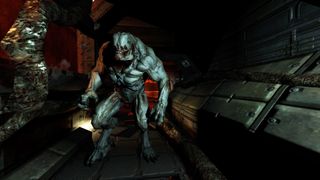
While Carmack’s influence is present in all id early games, Doom 3 is the one where his ideals shine through most clearly. It was Carmack who pushed to make a third Doom game after Quake 3, when the original plan was to design a multiplayer RPG called Quest. This led to Carmack issuing an ultimatum to the main proponents for Quest, Adrian Carmack and Kevin Cloud, threatening that he would leave the company unless they made Doom 3. “Obviously no fun for anyone involved,” Carmack later wrote in a .plan file (a prototypical hybrid between a blog post and social media), “but the project direction was changed, new hires have been expedited, and the design work has begun.” There’s no record of Cloud or the other Carmack’s views on the topic from the time, but in a G4 documentary on the making of Doom 3, Cloud acknowledges his original position as “wrong” and that “[Carmack’s] decision was great”.
Doom 3 is the one where the art and design revolves most heavily around the technology.
Doom 3 is the one where the art and design revolves most heavily around the technology.
That same .plan file also outlines Carmack’s reasoning for making Doom 3, namely “a general lack of excitement for the proposed plan, the warmth that [Return to Castle] Wolfenstein was met with at E3, and excitement about what we can do with the latest rendering technology”. This last point also hints at Carmack’s influence on the project. Of all the Doom games, Doom 3 is the one where the art and design revolves most heavily around the technology. Its unified lighting and shadowing system enabled most of the game’s light sources to be computed in real-time. Combined with Carmack’s homebrewed stencil-shadowing algorithm (known today as Carmack’s Reverse) the result was a hugely advanced light and shadow system perfect for creating oppressive, moody environments.
Doom 3’s design followed on from these techniques, taking the scarier elements of the original Doom and using them to build a full-blown survival horror experience, one built not around generating a sense of power, but a sense of fear. Speaking to Polygon in 2012, id Software CEO Todd Hollenshead explained how the game’s combat was designed around your flashlight, which pierced through the gloom. “The purity of the game is that you could either have the flashlight, or have the gun, it was just a choice you had to make in the game. I think that, for the game we made at the time, it was the right decision.”
Hell’s light
(Image credit: id Software)
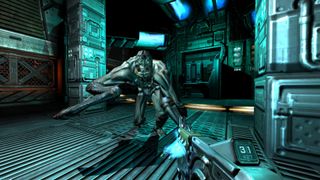
In more recent years, Doom 3’s reputation has diminished, with a gradual acknowledgement that although its visuals may be atmospheric, its combat is flat and sluggish, and its environments cramped and constraining. Id Software itself backtracked on some of the game’s ideas post-release, altering the flashlight for the game’s BFG edition so players could switch it on while holding their gun.
Doom 4
(Image credit: id Software)
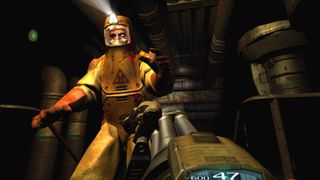
Id Software followed Doom 3 with the expansion pack Resurrection of Evil (which, in another concession to popular trends, featured a Half-Life 2-style gravity gun) before moving onto its next project, the post-apocalyptic shooter Rage. But this wasn’t the only game id had in the pipeline. At QuakeCon 2007, John Carmack hinted that a new Doom game was in development, with Doom 4 being informally revealed the following year via a recruitment ad.
Snippets about the game trickled out across the next few years. Speaking to GameSpot in 2009, Hollenshead stated that Doom 4 was “very much deep in development”, and that “everything I’ve seen on it is classic Doom”. When asked how it related to Doom 3, Hollenshead’s answer was unclear, “It’s not a sequel to Doom 3, but it’s not a reboot either. Doom 3 was sort of a reboot. It’s a little bit different from those.”
Doom (2016)
(Image credit: id Software)
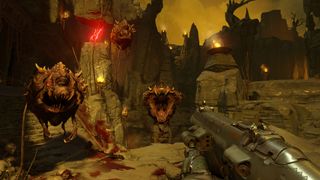
This was the challenge that id Software faced. So what was the solution? It started with asking some fundamental questions. “What do we want to make and what do we think fans want to play?” said Marty Stratton in a 2016 interview with VentureBeat. “We got some groups of people together and did a lot of looking back at the original Doom and Doom 2, as well as Doom 3. We took a holistic approach to the question of what, fundamentally, is the DNA of Doom. Then we started to build around that.”
Rip and tear you go
(Image credit: id Software)
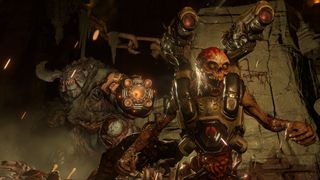
Id decided the story should never take precedence over the action.
Id decided the story should never take precedence over the action.
Perhaps most importantly of all, id decided the story should never take precedence over the action, echoing John Carmack’s design thoughts for the original Doom. Stratton cites a moment early in the game designed very much to set the tone. “That first thing, where Samuel [Hayden] tries to talk to you and you throw the monitor away, that was very much, ‘I’m here to kill demons’.”
The end result was a renewed vision for the linear, singleplayer FPS, the polar opposite of id Software’s plans for Doom 4, and something largely out of step with popular FPS conventions of the time. It was also excellent. “With Doom’s campaign, id Software found a sweet spot nestled somewhere between nostalgia and modernity that celebrates the pulpy sheen of big-budget shooters and resurrects an intense, simplified focus on the shooting itself,” wrote James Davenport inPC Gamer’s Doom 2016 review, awarding it a score of 88. That might be a little lower than the 90 of Doom 3 and the 94 of Doom 2, but it’s worth noting that not everything in Doom’s reboot worked. If you forgot that Doom 2016 shipped with a multiplayer mode, for example, that wouldn’t be surprising given how flat and lacking in personality it was. The game also featured a ‘Snapmap’ level editor that was interesting in theory, but too constrained in its toolset to facilitate a mapping community.
Crucially, though, the important part of Doom’s reboot, the singleplayer campaign, worked. Moreover, it proved that linear, singleplayer shooters could still be innovative and successful at the highest levels of development.
Doom Eternal
(Image credit: id Software)
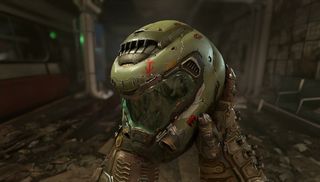
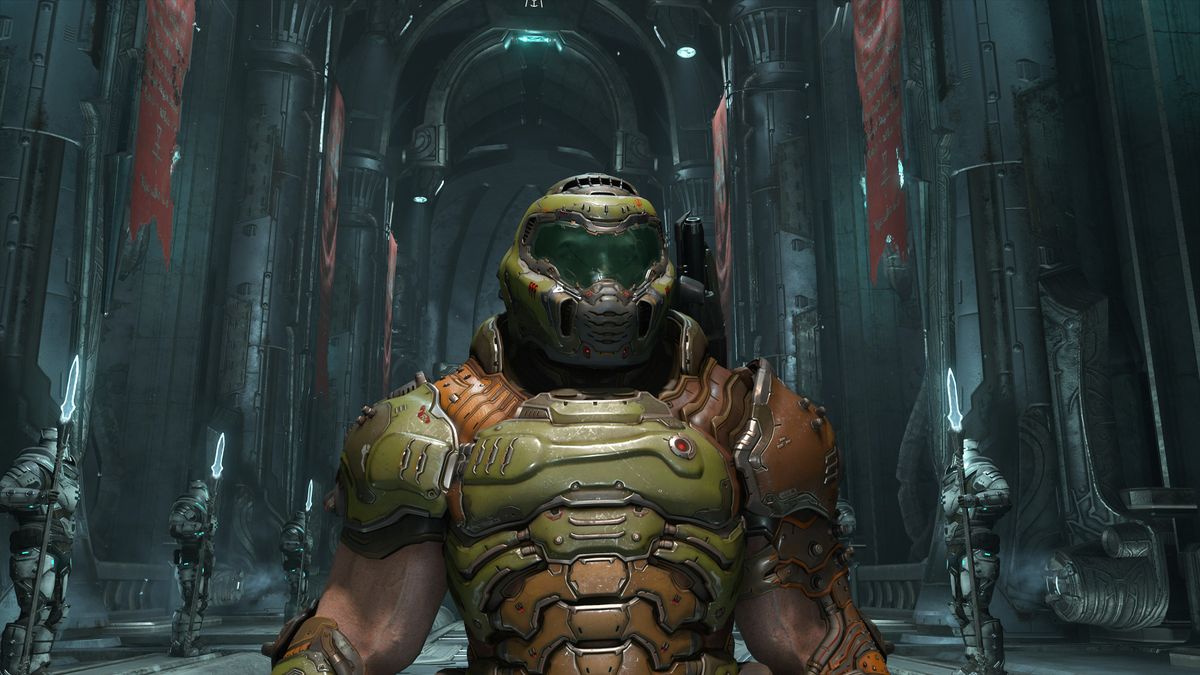
Building a game that genuinely lives up to Doom’s monstrous reputation is no mean feat, and you’d think that id Software would be satisfied with what it pulled off in 2016’s reboot. But the studio believed it could do better. “As fun as the last Doom was, there was a monotony to it,” said Marty Stratton to PC Gamer in 2019. “In the later levels especially it felt like corridor, arena, corridor, arena.”
For the sequel, Doom Eternal, id Software wanted to blow the doors off. “From the very start to the final boss, players will be seeing things they’d never expect from a Doom game.” At the heart of this was, again, the glory kill system. But id Software would take the idea of exploiting enemies to your advantage and massively expand it. Now, you’d be able to burn enemies with a shoulder-mounted flamethrower, causing them to drop armour when shot. Each demon would also have specific vulnerabilities to certain weapons, enabling you to take them out quicker and letting id pile on greater pressure. In short, no longer would you be killing mindlessly, your attacks would be precise and devastating.
(Image credit: id Software)
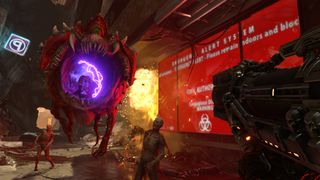
As a sequel, Eternal intended a far more extensive overhaul than Doom 2 did over the 1993 original. But with adding all this stuff came a risk, namely losing sight of the gleeful simplicity at the heart of the series. Does Doom need a more involved story, or platforming sequences? Id Software was confident it could get the tone right. “As long as the solution to every problem involves the player being aggressive somehow, it feels like Doom,” Stratton said to PC Gamer.
When Eternal arrived in 2020, the initial response was ecstatic. “Doom Eternalis a celebration of excess. Excess in sin, in violence, scale, speed and volume. I’ve never played a shooter this intense and demanding,” said James Davenport in his PC Gamer review, awarding the game a score of 94. In the wake of release, however, criticisms of the game began to grow. That the added story elements bogged the game down. That the platforming elements were unnecessary and annoying. Perhaps the most significant was that the combat was too restrictive, with particular focus on the Marauder, an enemy that required players to respond to their attacks in a specific pattern.
Unlike the 2016 reboot, Eternal is a game that takes time to master.
Unlike the 2016 reboot, Eternal is a game that takes time to master.
Id Software was bullish in the face of such criticism, with Eternal creative director Hugo Martin insisting that the Marauder was “crystallising everything about the game”. Nonetheless, there is a sense that Eternal experienced a more problematic development to 2016’s Doom. The hotly touted invasion-based multiplayer was not available on release and was ultimately cancelled, with id Software blaming “the unforeseen consequences of the pandemic and remote working” for its absence, and instead focusing on a singleplayer horde mode. Meanwhile, Eternal’s composer Mick Gordon described Eternal as a “difficult project”, stating that he and the entire Eternal team experienced brutal crunch, and accusing Stratton of poor management, accusations that Stratton rejects.
Yet while Eternal may have endured a rougher critical and developmental ride that its predecessor. Today, the consensus is that it is probably the best single-player FPS around. Unlike the 2016 reboot, Eternal is a game that takes time to master. But once you have mastered it, it offers a level of thrill and intensity unlike any other single-player shooter. The two expansions that followed Eternal pushed those ideas to the limit, demonstrating the full potential of the Doom Slayer’s combat abilities.
PRODUCTSDoom 2Doom EternalDoomDoom 3
PRODUCTS
More about fpsTeam Fortress 2 just had the single biggest trade in its history, with ‘the absolute best hat you can get’ going for around $40KThe most important tool in Remedy’s new co-op FPS is the shower: ‘Saving water is essential’LatestToday’s Wordle answer for Saturday, January 11See more latest►
More about fpsTeam Fortress 2 just had the single biggest trade in its history, with ‘the absolute best hat you can get’ going for around $40KThe most important tool in Remedy’s new co-op FPS is the shower: ‘Saving water is essential’LatestToday’s Wordle answer for Saturday, January 11See more latest►
More about fpsTeam Fortress 2 just had the single biggest trade in its history, with ‘the absolute best hat you can get’ going for around $40KThe most important tool in Remedy’s new co-op FPS is the shower: ‘Saving water is essential’
More about fps
Team Fortress 2 just had the single biggest trade in its history, with ‘the absolute best hat you can get’ going for around $40KThe most important tool in Remedy’s new co-op FPS is the shower: ‘Saving water is essential’

Team Fortress 2 just had the single biggest trade in its history, with ‘the absolute best hat you can get’ going for around $40K
Team Fortress 2 just had the single biggest trade in its history, with ‘the absolute best hat you can get’ going for around $40K
The most important tool in Remedy’s new co-op FPS is the shower: ‘Saving water is essential’
The most important tool in Remedy’s new co-op FPS is the shower: ‘Saving water is essential’
LatestToday’s Wordle answer for Saturday, January 11See more latest►
Latest
Today’s Wordle answer for Saturday, January 11
Today’s Wordle answer for Saturday, January 11
Today’s Wordle answer for Saturday, January 11
See more latest►
Most Popular
The Witcher 3’s now 2-year-old bonus quest is our first taste of the ‘vibe’ CD Projekt is going for in The Witcher 4
2024 was the year updates for old games beat out all the new ones for me
Train like you game with this adventure-inspired workout
‘It’s simply impossible to make a difficulty level that’s just right for all players’: How Final Fantasy 14’s lead battle designer has been playing a precarious balancing game for Dawntrail’s dungeons and raids
Please join me in getting super excited for all the cool looking survival games coming in 2025 (and beyond)
Competitive shooters are at a crucial crossroads in 2025: ‘sweaty’ teamplay vs. casual fun
Call of Duty’s $28 Squid Game skins are the perfect crossover for our capitalist dystopia, and Activision knows exactly what it’s doing
These are the 14 biggest upcoming RPGs of 2025—get ready for another amazing year for the genre
Five new Steam games you probably missed (January 6, 2025)
I’ve seen enough: No more forcing singleplayer studios to make mediocre live service games
HARDWARE BUYING GUIDESLATEST GAME REVIEWS1Best Steam Deck accessories in Australia for 2025: Our favorite docks, powerbanks and gamepads2Best graphics card for laptops: the mobile GPUs I’d want in my next gaming laptop3Best mini PCs in 2025: The compact computers I love the most4Best 14-inch gaming laptop: The top compact gaming laptops I’ve held in these hands5Best Mini-ITX motherboards in 2025: My pick from all the mini mobo marvels I’ve tested1Thank Goodness You’re Here! review2Shiren the Wanderer: The Mystery Dungeon of Serpentcoil Island review3WD Black SN850X 8 TB NVMe SSD review4Ikea Utespelare desk review5Asus ROG Harpe Ace Mini wireless mouse review
HARDWARE BUYING GUIDESLATEST GAME REVIEWS1Best Steam Deck accessories in Australia for 2025: Our favorite docks, powerbanks and gamepads2Best graphics card for laptops: the mobile GPUs I’d want in my next gaming laptop3Best mini PCs in 2025: The compact computers I love the most4Best 14-inch gaming laptop: The top compact gaming laptops I’ve held in these hands5Best Mini-ITX motherboards in 2025: My pick from all the mini mobo marvels I’ve tested1Thank Goodness You’re Here! review2Shiren the Wanderer: The Mystery Dungeon of Serpentcoil Island review3WD Black SN850X 8 TB NVMe SSD review4Ikea Utespelare desk review5Asus ROG Harpe Ace Mini wireless mouse review
HARDWARE BUYING GUIDESLATEST GAME REVIEWS1Best Steam Deck accessories in Australia for 2025: Our favorite docks, powerbanks and gamepads2Best graphics card for laptops: the mobile GPUs I’d want in my next gaming laptop3Best mini PCs in 2025: The compact computers I love the most4Best 14-inch gaming laptop: The top compact gaming laptops I’ve held in these hands5Best Mini-ITX motherboards in 2025: My pick from all the mini mobo marvels I’ve tested1Thank Goodness You’re Here! review2Shiren the Wanderer: The Mystery Dungeon of Serpentcoil Island review3WD Black SN850X 8 TB NVMe SSD review4Ikea Utespelare desk review5Asus ROG Harpe Ace Mini wireless mouse review
HARDWARE BUYING GUIDESLATEST GAME REVIEWS1Best Steam Deck accessories in Australia for 2025: Our favorite docks, powerbanks and gamepads2Best graphics card for laptops: the mobile GPUs I’d want in my next gaming laptop3Best mini PCs in 2025: The compact computers I love the most4Best 14-inch gaming laptop: The top compact gaming laptops I’ve held in these hands5Best Mini-ITX motherboards in 2025: My pick from all the mini mobo marvels I’ve tested1Thank Goodness You’re Here! review2Shiren the Wanderer: The Mystery Dungeon of Serpentcoil Island review3WD Black SN850X 8 TB NVMe SSD review4Ikea Utespelare desk review5Asus ROG Harpe Ace Mini wireless mouse review
HARDWARE BUYING GUIDESLATEST GAME REVIEWS
1Best Steam Deck accessories in Australia for 2025: Our favorite docks, powerbanks and gamepads
1Best Steam Deck accessories in Australia for 2025: Our favorite docks, powerbanks and gamepads
1
Best Steam Deck accessories in Australia for 2025: Our favorite docks, powerbanks and gamepads
2Best graphics card for laptops: the mobile GPUs I’d want in my next gaming laptop
2Best graphics card for laptops: the mobile GPUs I’d want in my next gaming laptop
2
Best graphics card for laptops: the mobile GPUs I’d want in my next gaming laptop
3Best mini PCs in 2025: The compact computers I love the most
3Best mini PCs in 2025: The compact computers I love the most
3
Best mini PCs in 2025: The compact computers I love the most
4Best 14-inch gaming laptop: The top compact gaming laptops I’ve held in these hands
4Best 14-inch gaming laptop: The top compact gaming laptops I’ve held in these hands
4
Best 14-inch gaming laptop: The top compact gaming laptops I’ve held in these hands
5Best Mini-ITX motherboards in 2025: My pick from all the mini mobo marvels I’ve tested
5Best Mini-ITX motherboards in 2025: My pick from all the mini mobo marvels I’ve tested
5
Best Mini-ITX motherboards in 2025: My pick from all the mini mobo marvels I’ve tested
1Thank Goodness You’re Here! review
1Thank Goodness You’re Here! review
1
Thank Goodness You’re Here! review
2Shiren the Wanderer: The Mystery Dungeon of Serpentcoil Island review
2Shiren the Wanderer: The Mystery Dungeon of Serpentcoil Island review
2
Shiren the Wanderer: The Mystery Dungeon of Serpentcoil Island review
3WD Black SN850X 8 TB NVMe SSD review
3WD Black SN850X 8 TB NVMe SSD review
3
WD Black SN850X 8 TB NVMe SSD review
4Ikea Utespelare desk review
4Ikea Utespelare desk review
4
Ikea Utespelare desk review
5Asus ROG Harpe Ace Mini wireless mouse review
5Asus ROG Harpe Ace Mini wireless mouse review
5
Asus ROG Harpe Ace Mini wireless mouse review
