HardwareFreakishly large graphics cards and super-hot SSDs mean the fundamentals of PC design needs a big changeWhen you purchase through links on our site, we may earn an affiliate commission.Here’s how it works.
HardwareFreakishly large graphics cards and super-hot SSDs mean the fundamentals of PC design needs a big changeWhen you purchase through links on our site, we may earn an affiliate commission.Here’s how it works.
When you purchase through links on our site, we may earn an affiliate commission.Here’s how it works.
(Image credit: RichVintage, Getty)

In my humble opinion, the ATX standard is broken. The PCs we know and love have evolved so much over the last 30 years. Small revisions and additions to the standard aren’t meeting the needs and requirements of a 2024 era PC, to say nothing of the demands of a PC as we move towards—and into the 2030’s.
At its most basic, ATX exists to ensure compatibility across the PC ecosystem. In theory, any ATX motherboard can be installed into any ATX case with any ATX power supply. The dimensions, mounting points, the shape and location of the I/O panel and the positioning of the expansion slots are key to this.
Over the years the ATX standard has undergone many revisions and expansions. The most well known of these are the addition of the microATX and Mini-ITX standards, though there are others more relevant to workstation and enterprise motherboards. Extended ATX is one we often see in high-end consumer motherboards.
PC power supplies are also required to meet certain specifications. That includes the physical connectors and the requirement to supply various voltages within tolerances. These include the 12V, 5V and 3.3V rails, so that it ensures compatibility with—hopefully—all motherboards.
The most recent major ATX power supply revision is ATX 3.0, which was released in February of 2022. ATX 3.1 is coming this year. It introduces the 12V-2x6 16-pin connector which can supply 600W of power to the thirstiest graphics cards. It replaces the issue prone 12VHPWR connector,which has not exactly gone well.
There are a multitude of reasons why I believe there’s a need for an ATX replacement. These include the rise of M.2, the physical size and demands of modern graphics cards, cooling requirements, power efficiency, cable management, and the need to prepare for future technologies.
The biggest gaming news, reviews and hardware deals
But there are some parts of the standard that are perfectly fine. The positioning of the rear I/O panel and the motherboard mounting points are two features that have stood the test of time.
M.2 wasn’t even a twinkle in daddy Intel’s eye 30 years ago
NVMe SSD cooling is getting out of hand(Image credit: Sabrent)
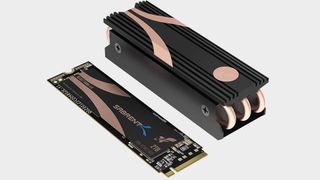
Ditching M.2 in favor of an alternative form factor would remove the necessity for expansive motherboard mounted heatsinks, it would free up motherboard PCB space for other components (or make them cheaper), and they require inefficient 3.3V power.
For some reason, competing cabled standards including U.2 and U.3 connections have never taken off in the consumer space. U.3 includes support for 12V power. Removing 3.3V support would fix one of the inefficiencies of modern ATX power supplies. But, I’ll get to that shortly.
NVMe the way it should be(Image credit: Intel)
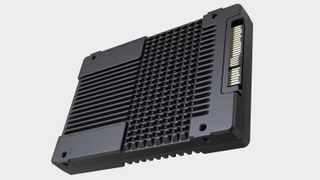
Make backside cable connectors mandatory
Cables? What cables?(Image credit: Future)
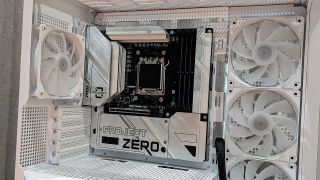
Mounting all of the motherboard connectors and headers on the rear of the motherboard would be one of the easier changes to mandate. Motherboard manufacturers are already experimenting in this regard, withMSI’s Project ZeroandAsus' BTFconcepts being prominent examples.
Rear mounted motherboard connectors improve aesthetics and case airflow. It would also make the system easier to access. M.2 drives are a pain to install, whereas a SATA (or U.3) SSD could be simply and easily mounted and attached with none of the fiddliness of M.2 drives.
Another example many builders have probably come across is the difficulty of accessing the EPS power connectors if you have top mounted fans or an AIO cooler installed. Rear mounted connectors completely remove this issue, and others like it, such as cables that attach to headers along the bottom of the motherboard. They can be difficult to access if you have a PSU shroud immediately below them, or have expansion cards installed.
So, backside motherboard connectors make your system look better, improve case airflow, are relatively easy for motherboard manufacturers to implement, and make system modifications easier. It’s a no brainer.
Graphics cards have become physically dominant
We’re sure to see more four and five slot graphics cards(Image credit: Asus)
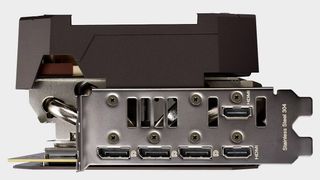
Changing the discrete graphics card form factor is much easier said than done. It’s almost laughable how physically large a modern high-performance graphics card is. Compare them to the heatsink-less single slot designs from the 1990’s! Interestingly, though, a quad slotRTX 4090can theoretically be installed into an ATX case from 30 years ago when single slot, half length passive cards were common.
No fans? No heatsink!(Image credit: Fritzchens Fritz)
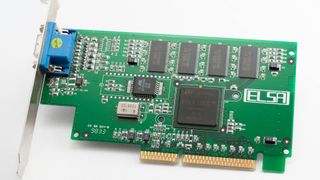
A modern graphics card still needs to be installed into a slot that physically differs little from the AGP slots of the 1990’s. The same can be said of a case’s expansion slots. Anti-sag brackets address the weight aspect, but the reason they exist at all is proof that modern graphics cards are nothing like their 1990’s ancestors. Their dimensions and weight, along with runaway power and cooling demands have come too far to be sustainable. What’s next? 600W five-slot cards? That’s ridiculous.
This brings me to the difficult part. I’d like to see a new graphics card form factor. A large graphics card already protrudes above the top of the I/O bracket. Why not take that a step further? Instead of a card that’s 140mm tall, why not make it 180mm? Makers could install higher CFM, lower RPM fans that are quieter, while allowing the cards themselves to be thinner or shorter. You could mount them vertically, away from the motherboard, not unlike you can do with riser cables now. That way we wouldn’t have to resort to cases that are more like cubes than the rectangular towers they are now.
the PCIe graphics card form factor we know and love is trending in an unsustainable direction.
the PCIe graphics card form factor we know and love is trending in an unsustainable direction.
Another option would be to go in the opposite direction, so, let’s say a card takes up five or six slots. In theory, a GPU cooler could incorporate a single 120mm or 140mm fan to direct cool air from the front of the case over a huge heatsink surface area and straight out the rear of the case. That idea could be a bit silly, though.
That’s just a spitballing of ideas, but with graphics cards trending upwards in power consumption, which means ever steeper cooling requirements, the PCIe graphics card form factor we know and love is trending in an unsustainable direction.
The case for ATX12VO
(Image credit: Anandtech)
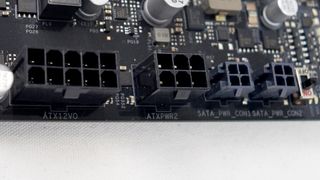
The problem with ATX (and SFX) power supplies is that they carry the legacies of prior decades. These days, PCs rely far more heavily on the 12V rail of the power supply. System components that require 3.3V (such as M.2 drives) or 5V (USB) could use motherboard mounted step-down circuitry to supply the power those devices require. The motherboard is already required to route these voltages anyway.
The upside is that ATX12VO power supplies would be much simpler in design with better efficiency. That means a combination of less waste heat and lower power consumption, a longer lifespan and cheaper purchase price.
One of the potential stumbling blocks I see is the rise of USB Power Delivery. ATX12VO PCs with several USB-PD supporting ports would be challenging for motherboard makers to implement.
ATX12VO is probably the change I’d award the lowest priority to. I’d love to see better efficiency and millions of ATX12VO power supplies combining to lower global energy consumption, but the ongoing development of ATX power supplies, with ATX 3.0 and 3.1 being the latest examples, means ATX12VO has a steep—but not insurmountable climb ahead of it, if it’s to ever see widespread adoption.
As we move towards the 2030’s there will be new considerations
Since the mid 1990’s PCs have required SDRAM, DDR1, DDR2 and so on. Their physical dimensions remain essentially the same, even if they are not compatible. A couple of weeks ago, I wrote a story after spotting anAsus ROG motherboard with SO-DIMM slots, and it got me thinking about how desktop PC memory could do with a physical change, if only to create a little bit of extra PCB space for an extra M.2 slot.
Could CAMM memory, or something like it, replace DIMM slots?(Image credit: PC World)
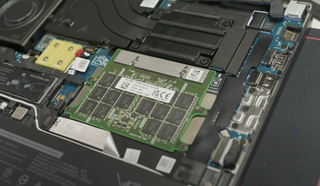
Might we see something similar to CAMM memory in the years ahead? How aboutoptical RAM?It’s nice to think about, but honestly, we’re far more likely to have the same RGB equipped DDR7 in 10 years from now. Whatever the case, a smaller RAM footprint would not go astray, if the industry could get on board with it.
Remember BTX?
Ahh, do you remember BTX? That was Intel’s attempt to replace the ATX motherboard form factor in the mid-2000’s with something more relevant in the 21st century. Apart from a few concepts and OEM systems, BTX came and went with a whimper.
One of very few BTX motherboards(Image credit: Anandtech)
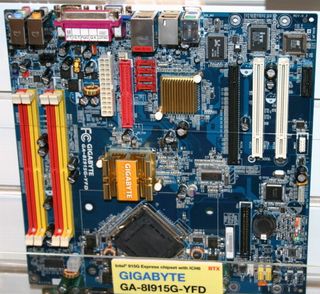
It did have some interesting properties, one of which was swapping the positioning of the I/O panel and expansion slots. It also gave the CPU ‘first dibs’ on incoming case airflow. Some systems had the ability to vertically mount the graphics card, or even have it positioned opposite the motherboard, allowing airflow to move more freely though the case.
It was developed to address the severe heat issues affecting Intel’s Pentium 4 era CPUs. History is repeating…
It was developed to address the severe heat issues affecting Intel’s Pentium 4 era CPUs. History is repeating…
BTX was a novel idea, and one which had some real advantages. It was developed to address the severe heat issues affecting Intel’s Pentium 4 era CPUs. History is repeating…
Some closing thoughts
Any replacement of the ATX standard would require near universal industry support. Intel can’t come over the top and say: ‘Let’s do it this way’ as it could in years past. Something like an IEEE group or some other industry body made up of all the key players is the only realistic way forward.
Such changes affect every area of not just the PC, but everything else to some extent. From a simple motherboard to laptops to data centers covering football fields: all would be affected in at least some way.
Sadly, if I had to put a bet on it, I’d say the chances of major form factor changes are pretty much zero in the short term
Sadly, if I had to put a bet on it, I’d say the chances of major form factor changes are pretty much zero in the short term
I say let the enterprise folks do their thing. Those folks can chuck a billion dollars at a problem and solve it. But the humble PC needs a redesign that introduces better power efficiency, improved cooling, and improved cable management. Add a dash of simplicity and more attractive aesthetics, and we’ve got a bunch of things all gamers would benefit from.
Sadly, if I had to put a bet on it, I’d say the chances of major form factor changes are pretty much zero in the short term. The industry is just too big these days, there’s too much money and time invested in the existing ecosystem. A change of momentum of this scale when so many companies have their fingers in the ATX pie makes imminent change unlikely.
More about hardwareIf you’re trying to convince me your ‘companionship’ robot is ‘lifelike’, maybe don’t rip her face off in the demo videoIs the new RTX 5070 really as fast as Nvidia’s previous flagship RTX 4090 GPU? Turns out the answer is yes. Kinda.LatestWatching an all-romances speedrun of the legendarily janky Fallout: New Vegas is a delightSee more latest►
More about hardwareIf you’re trying to convince me your ‘companionship’ robot is ‘lifelike’, maybe don’t rip her face off in the demo videoIs the new RTX 5070 really as fast as Nvidia’s previous flagship RTX 4090 GPU? Turns out the answer is yes. Kinda.LatestWatching an all-romances speedrun of the legendarily janky Fallout: New Vegas is a delightSee more latest►
More about hardwareIf you’re trying to convince me your ‘companionship’ robot is ‘lifelike’, maybe don’t rip her face off in the demo videoIs the new RTX 5070 really as fast as Nvidia’s previous flagship RTX 4090 GPU? Turns out the answer is yes. Kinda.
More about hardware
If you’re trying to convince me your ‘companionship’ robot is ‘lifelike’, maybe don’t rip her face off in the demo videoIs the new RTX 5070 really as fast as Nvidia’s previous flagship RTX 4090 GPU? Turns out the answer is yes. Kinda.

If you’re trying to convince me your ‘companionship’ robot is ‘lifelike’, maybe don’t rip her face off in the demo video
If you’re trying to convince me your ‘companionship’ robot is ‘lifelike’, maybe don’t rip her face off in the demo video
Is the new RTX 5070 really as fast as Nvidia’s previous flagship RTX 4090 GPU? Turns out the answer is yes. Kinda.
Is the new RTX 5070 really as fast as Nvidia’s previous flagship RTX 4090 GPU? Turns out the answer is yes. Kinda.
LatestWatching an all-romances speedrun of the legendarily janky Fallout: New Vegas is a delightSee more latest►
Latest
Watching an all-romances speedrun of the legendarily janky Fallout: New Vegas is a delight
Watching an all-romances speedrun of the legendarily janky Fallout: New Vegas is a delight
Watching an all-romances speedrun of the legendarily janky Fallout: New Vegas is a delight
See more latest►
Most Popular
This bizarre roguelike has a new take on the Vampire Survivors formula: letting you build your own custom weapons out of brains, eyeballs, and chimpanzee spines
18 games the PC Gamer team can’t wait to play in 2025
The Witcher 3’s now 2-year-old bonus quest is our first taste of the ‘vibe’ CD Projekt is going for in The Witcher 4
2024 was the year updates for old games beat out all the new ones for me
Train like you game with this adventure-inspired workout
‘It’s simply impossible to make a difficulty level that’s just right for all players’: How Final Fantasy 14’s lead battle designer has been playing a precarious balancing game for Dawntrail’s dungeons and raids
Please join me in getting super excited for all the cool looking survival games coming in 2025 (and beyond)
Competitive shooters are at a crucial crossroads in 2025: ‘sweaty’ teamplay vs. casual fun
Call of Duty’s $28 Squid Game skins are the perfect crossover for our capitalist dystopia, and Activision knows exactly what it’s doing
These are the 14 biggest upcoming RPGs of 2025—get ready for another amazing year for the genre
HARDWARE BUYING GUIDESLATEST GAME REVIEWS1Best Steam Deck accessories in Australia for 2025: Our favorite docks, powerbanks and gamepads2Best graphics card for laptops: the mobile GPUs I’d want in my next gaming laptop3Best mini PCs in 2025: The compact computers I love the most4Best 14-inch gaming laptop: The top compact gaming laptops I’ve held in these hands5Best Mini-ITX motherboards in 2025: My pick from all the mini mobo marvels I’ve tested1Thank Goodness You’re Here! review2Shiren the Wanderer: The Mystery Dungeon of Serpentcoil Island review3WD Black SN850X 8 TB NVMe SSD review4Ikea Utespelare desk review5Asus ROG Harpe Ace Mini wireless mouse review
HARDWARE BUYING GUIDESLATEST GAME REVIEWS1Best Steam Deck accessories in Australia for 2025: Our favorite docks, powerbanks and gamepads2Best graphics card for laptops: the mobile GPUs I’d want in my next gaming laptop3Best mini PCs in 2025: The compact computers I love the most4Best 14-inch gaming laptop: The top compact gaming laptops I’ve held in these hands5Best Mini-ITX motherboards in 2025: My pick from all the mini mobo marvels I’ve tested1Thank Goodness You’re Here! review2Shiren the Wanderer: The Mystery Dungeon of Serpentcoil Island review3WD Black SN850X 8 TB NVMe SSD review4Ikea Utespelare desk review5Asus ROG Harpe Ace Mini wireless mouse review
HARDWARE BUYING GUIDESLATEST GAME REVIEWS1Best Steam Deck accessories in Australia for 2025: Our favorite docks, powerbanks and gamepads2Best graphics card for laptops: the mobile GPUs I’d want in my next gaming laptop3Best mini PCs in 2025: The compact computers I love the most4Best 14-inch gaming laptop: The top compact gaming laptops I’ve held in these hands5Best Mini-ITX motherboards in 2025: My pick from all the mini mobo marvels I’ve tested1Thank Goodness You’re Here! review2Shiren the Wanderer: The Mystery Dungeon of Serpentcoil Island review3WD Black SN850X 8 TB NVMe SSD review4Ikea Utespelare desk review5Asus ROG Harpe Ace Mini wireless mouse review
HARDWARE BUYING GUIDESLATEST GAME REVIEWS1Best Steam Deck accessories in Australia for 2025: Our favorite docks, powerbanks and gamepads2Best graphics card for laptops: the mobile GPUs I’d want in my next gaming laptop3Best mini PCs in 2025: The compact computers I love the most4Best 14-inch gaming laptop: The top compact gaming laptops I’ve held in these hands5Best Mini-ITX motherboards in 2025: My pick from all the mini mobo marvels I’ve tested1Thank Goodness You’re Here! review2Shiren the Wanderer: The Mystery Dungeon of Serpentcoil Island review3WD Black SN850X 8 TB NVMe SSD review4Ikea Utespelare desk review5Asus ROG Harpe Ace Mini wireless mouse review
HARDWARE BUYING GUIDESLATEST GAME REVIEWS
1Best Steam Deck accessories in Australia for 2025: Our favorite docks, powerbanks and gamepads
1Best Steam Deck accessories in Australia for 2025: Our favorite docks, powerbanks and gamepads
1
Best Steam Deck accessories in Australia for 2025: Our favorite docks, powerbanks and gamepads
2Best graphics card for laptops: the mobile GPUs I’d want in my next gaming laptop
2Best graphics card for laptops: the mobile GPUs I’d want in my next gaming laptop
2
Best graphics card for laptops: the mobile GPUs I’d want in my next gaming laptop
3Best mini PCs in 2025: The compact computers I love the most
3Best mini PCs in 2025: The compact computers I love the most
3
Best mini PCs in 2025: The compact computers I love the most
4Best 14-inch gaming laptop: The top compact gaming laptops I’ve held in these hands
4Best 14-inch gaming laptop: The top compact gaming laptops I’ve held in these hands
4
Best 14-inch gaming laptop: The top compact gaming laptops I’ve held in these hands
5Best Mini-ITX motherboards in 2025: My pick from all the mini mobo marvels I’ve tested
5Best Mini-ITX motherboards in 2025: My pick from all the mini mobo marvels I’ve tested
5
Best Mini-ITX motherboards in 2025: My pick from all the mini mobo marvels I’ve tested
1Thank Goodness You’re Here! review
1Thank Goodness You’re Here! review
1
Thank Goodness You’re Here! review
2Shiren the Wanderer: The Mystery Dungeon of Serpentcoil Island review
2Shiren the Wanderer: The Mystery Dungeon of Serpentcoil Island review
2
Shiren the Wanderer: The Mystery Dungeon of Serpentcoil Island review
3WD Black SN850X 8 TB NVMe SSD review
3WD Black SN850X 8 TB NVMe SSD review
3
WD Black SN850X 8 TB NVMe SSD review
4Ikea Utespelare desk review
4Ikea Utespelare desk review
4
Ikea Utespelare desk review
5Asus ROG Harpe Ace Mini wireless mouse review
5Asus ROG Harpe Ace Mini wireless mouse review
5
Asus ROG Harpe Ace Mini wireless mouse review
