Our VerdictA clever yet frustratingly muddled follow-up to Monster Train.
Our VerdictA clever yet frustratingly muddled follow-up to Monster Train.
Our Verdict
Our Verdict
A clever yet frustratingly muddled follow-up to Monster Train.
PC Gamer’s got your backOur experienced team dedicates many hours to every review, to really get to the heart of what matters most to you.Find out more about how we evaluate games and hardware.
PC Gamer’s got your backOur experienced team dedicates many hours to every review, to really get to the heart of what matters most to you.Find out more about how we evaluate games and hardware.
Need to Know
Oh, Inkbound. I so desperately want to love you. You’re from the studio that mashed together deckbuilders and tower defence to makeMonster Train, one of my favourite games ever. This time though Shiny Shoe has mixed a Hades-style isometric roguelike with turn-based tactics and made a bit of an inky mess all over the floor. An interesting mess, with one excellent idea, but I’m still about to use up a lot of virtual ink complaining about its flaws.
Hades didn’t invent the isometric roguelike but it’s clearly a regular haunt in Shiny Shoe’s Steam library. The influence is everywhere, not just in its look, but in how Inkbound uses the roguelike structure as part of its story, steadily adding new dialogue to recurring characters you meet on runs and that gradually populate the main hub and directly acknowledging that you’re fighting through these scenarios again and again.
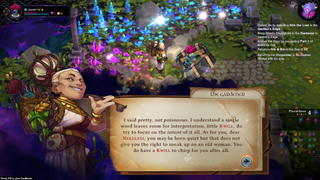
You’re a Needless (hey!), a warrior in some sort of magical library where evil ink is destroying all the poor storybooks… I think? It’s hard not to tune out when the cast are so tiresomely capital-Q quirky and the plot is the kind of fantasy hogwash where you feel yourself taking more psychic damage with every proper noun. It’s a story about stories, which only draws attention to the fact that it’s not a particularly compelling one itself.
Where it properly breaks away from Hades is that Inkbound is entirely turn-based. Battles start with enemies surrounding you and kindly telegraphing exactly how they’re going to attack. You’ve got a limited amount of movement and attack power each turn to deal as much damage as possible, build up enough shield to block incoming blows, or move out of the way so you avoid them entirely. A number hovers over your head telling you how much damage you’re going to take. See a skull next to that number? Start picking out a nice coffin.
Killing enemies, raising your defences, and sprinting and teleporting around the arena to steadily chip that deadly number down to zero delivers a smug sense of triumph that has me regularly punching the air. But thanks to a lack of clarity I’m just as often lowering that fist to scratch my head, as I’m left clueless how I’m expected to get out of a certain deadly situation. Positioning yourself and your enemies to avoid damage in a turn-based strategy game can’t help but remind me of PC Gamer favouriteInto The Breach. The genius of that game was in how clear and readable its little death dioramas were. You could have printed them in the puzzle pages of a newspaper. Inkbound not so much.
(Image credit: Shiny Shoe)
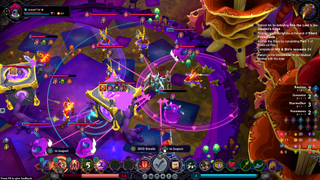
It’s also less reactive than I’d like. Multiple attacks are designed to toss enemies around the battlefield, but this rarely creates opportunities to reposition incoming attacks.
It’s also less reactive than I’d like. Multiple attacks are designed to toss enemies around the battlefield, but this rarely creates opportunities to reposition incoming attacks.
A crucial number above enemies’ heads shows how much damage they’re going to hit you for. I’ve had that number hidden from me because it’s overlapping another number on the screen, leaving whether I should prioritise attacking that enemy a dangerous mystery. You can get pretty far into a run wondering what on Earth I’m bellyaching about, but see if you feel the same way when the screen is crammed with enemies during one of its nastier (and not infrequent) difficulty spikes. Into the Breach, a game I promise to now stop shoehorning into this review, had a limited time-rewind feature that let you experiment and take risks. Inkbound would benefit from something similar to help mitigate its more frustrating and obtuse moments.
It’s also less reactive than I’d like. Multiple attacks are designed to toss enemies around the battlefield, but this rarely creates opportunities to reposition incoming attacks. One move that has you punching foes into each other feels like it should be the setup for something like this. Instead, fights still just consist of wailing on the enemy’s health bar as much as possible then running headless chicken-style around the arena in desperate search of relatively safe ground.
(Image credit: Shiny Shoe)
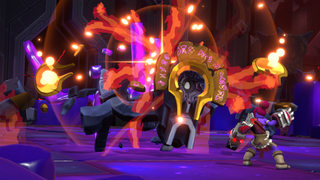
You can play the game in online co-op with up to three friends, and the game pushes you in that direction, especially with its almost MMO-like hub where other players can be seen scampering between vendors. In theory bringing multiple characters along should open up the strategy exponentially, allowing you to combine different builds and abilities into new synergies—but in practice that lack of clarity of information makes it difficult to keep track of what your friends are doing and why, and if anything more characters on screen only makes battles even less readable.
Those last several hundred words of moaning aren’t just because I’m an unpleasant little goblin. I’m aheartbrokengoblin, because along with all those issues there is enough good in here to keep me coming back. You get four starter loadouts, with so many excellent opportunities for customisation during a run that you can finish with them being almost unrecognisable from where you started. Some do stay consistently crap—my sincere congratulations if you’ve figured out how to get the mage that ties enemies together with thread to feel fun—but you shouldn’t struggle too much to find a decent brawler that’s enjoyable to shape.
You get three starting attacks, with space to obtain several more, and these can be augmented with bonuses like inflicting poison, giving you shield if you use them in a certain way, or increased area of effect. Naturally you’re trying to pick powers and upgrades that work well with each other, like an attack that’s devastatingly powerful but slow to recharge with another that reduces your cooldowns. Solid stuff, albeit nothing earth-shatteringly original. It’s the vestiges where the game starts getting clever, bordering on brilliant.
Smashing idea
(Image credit: Shiny Shoe)
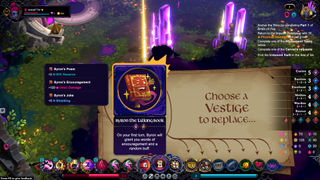
Vestiges are talismans that grant a specific boon, such as inflicting burning whenever you attack or granting bonus damage on your first turn. They also each belong to one or more “sets”—themed groups of vestiges. The more of a matching set you have, the more extra bonuses you unlock. So a vestige that adds bleed to your attacks, for example, will have “Eviscerator” as one of its sets, which grants bonus bleed damage if you have two of that set, buffs your attacks against enemies that are already bleeding if you have three, and heals you when you deal bleed if you have six.
We’ve seen equivalent concepts in other games, of course, but Inkbound’s cleverest twist is that it encourages you to smash your vestiges to bits. At certain points in your journey, you can choose to destroy a vestige, losing its core effect but permanently gaining double all its sets. Throw that bleed vestige into the grinder, for example, and from then on you’ll always have at least two points in Eviscerator, as if you had two extra vestiges of that type.
(Image credit: Shiny Shoe)
It’s often a deliciously difficult choice, because the vestiges you’ll benefit most from destroying are likely to be the ones whose powers synergise most with your build.
It’s often a deliciously difficult choice, because the vestiges you’ll benefit most from destroying are likely to be the ones whose powers synergise most with your build.
With limited vestige slots, you always want to be breaking them for those bonuses and making way for new ones. But it’s often a deliciously difficult choice, because the vestiges you’ll benefit most from destroying are likely to be the ones whose powers synergise most with your build, and you’re often sacrificing power in the present in the hope that you’ll build to greater heights in the future. The rarer and more powerful the vestige is, the more sets it belongs to, making your greatest and most irreplaceable treasures the most tempting targets for destruction. It feels like a genuinely new twist on roguelike character-building, and it’s in those moments of agonising over the best option that you can see most clearly that this is a game from the geniuses behind Monster Train.
As you complete runs, you gain permanent progression, but instead of improving your stats, levelling up just unlocks more vestiges, making your adventures increasingly interesting with a greater spread of possible combos, rather than simply easier. Exploring all those possibilities is where the game is at its best. But whenever I start to feel I have a really solid grip on my vestige strategy, that’s when I inevitably hit some wall of a battle where I can’t for the life of me figure out what I’m doing wrong.
After playing a couple of hours of multiplayer with one of the PCG team, he pretty much swore off the game entirely after one suddenly seemingly impossible fight, and even though I am still having fun with it myself, I can understand why. I’ll definitely return to Inkbound’s well every so often to see how it evolves and hopefully improves, but though it has its clever charms, it won’t be replacing Monster Train on my Steam Deck just yet.
The Verdict70Read our review policyInkboundA clever yet frustratingly muddled follow-up to Monster Train.
The Verdict
The Verdict
70Read our review policyInkboundA clever yet frustratingly muddled follow-up to Monster Train.
70Read our review policy
70
InkboundA clever yet frustratingly muddled follow-up to Monster Train.
Inkbound
A clever yet frustratingly muddled follow-up to Monster Train.
LatestHow to feed pegasus in Disney Dreamlight Valley20 hours in, Kingdom Come: Deliverance 2 is a mad, systems-driven sandbox that captures some of the best parts of games like StalkerDragonflight got WoW back on its feet, now we get to see if Blizzard can make the Worldsoul Saga runSee more latest►
LatestHow to feed pegasus in Disney Dreamlight Valley20 hours in, Kingdom Come: Deliverance 2 is a mad, systems-driven sandbox that captures some of the best parts of games like StalkerDragonflight got WoW back on its feet, now we get to see if Blizzard can make the Worldsoul Saga runSee more latest►
LatestHow to feed pegasus in Disney Dreamlight Valley20 hours in, Kingdom Come: Deliverance 2 is a mad, systems-driven sandbox that captures some of the best parts of games like StalkerDragonflight got WoW back on its feet, now we get to see if Blizzard can make the Worldsoul Saga runSee more latest►
Latest
How to feed pegasus in Disney Dreamlight Valley20 hours in, Kingdom Come: Deliverance 2 is a mad, systems-driven sandbox that captures some of the best parts of games like StalkerDragonflight got WoW back on its feet, now we get to see if Blizzard can make the Worldsoul Saga run

How to feed pegasus in Disney Dreamlight Valley
How to feed pegasus in Disney Dreamlight Valley
20 hours in, Kingdom Come: Deliverance 2 is a mad, systems-driven sandbox that captures some of the best parts of games like Stalker
20 hours in, Kingdom Come: Deliverance 2 is a mad, systems-driven sandbox that captures some of the best parts of games like Stalker
Dragonflight got WoW back on its feet, now we get to see if Blizzard can make the Worldsoul Saga run
Dragonflight got WoW back on its feet, now we get to see if Blizzard can make the Worldsoul Saga run
See more latest►
Most PopularTurtle Beach Stealth Pivot reviewIkea Matchspel gaming chair reviewASRock DeskMini X600 reviewZotac Zbox Magnus EN374070C reviewMinisforum AtomMan G7 Ti reviewSamsung Galaxy Book4 Ultra reviewNoctua NH-D15 G2 reviewGulikit KK3 Max reviewBallionaire reviewMarvel Rivals reviewBe Quiet! Dark Rock 5 review
Most PopularTurtle Beach Stealth Pivot reviewIkea Matchspel gaming chair reviewASRock DeskMini X600 reviewZotac Zbox Magnus EN374070C reviewMinisforum AtomMan G7 Ti reviewSamsung Galaxy Book4 Ultra reviewNoctua NH-D15 G2 reviewGulikit KK3 Max reviewBallionaire reviewMarvel Rivals reviewBe Quiet! Dark Rock 5 review
Most PopularTurtle Beach Stealth Pivot reviewIkea Matchspel gaming chair reviewASRock DeskMini X600 reviewZotac Zbox Magnus EN374070C reviewMinisforum AtomMan G7 Ti reviewSamsung Galaxy Book4 Ultra reviewNoctua NH-D15 G2 reviewGulikit KK3 Max reviewBallionaire reviewMarvel Rivals reviewBe Quiet! Dark Rock 5 review
Most Popular
Turtle Beach Stealth Pivot review
Ikea Matchspel gaming chair review
ASRock DeskMini X600 review
Zotac Zbox Magnus EN374070C review
Minisforum AtomMan G7 Ti review
Samsung Galaxy Book4 Ultra review
Noctua NH-D15 G2 review
Gulikit KK3 Max review
Ballionaire review
Marvel Rivals review
Be Quiet! Dark Rock 5 review
HARDWARE BUYING GUIDESLATEST GAME REVIEWS1Best Steam Deck accessories in Australia for 2025: Our favorite docks, powerbanks and gamepads2Best graphics card for laptops: the mobile GPUs I’d want in my next gaming laptop3Best mini PCs in 2025: The compact computers I love the most4Best 14-inch gaming laptop: The top compact gaming laptops I’ve held in these hands5Best Mini-ITX motherboards in 2025: My pick from all the mini mobo marvels I’ve tested1Thank Goodness You’re Here! review2Shiren the Wanderer: The Mystery Dungeon of Serpentcoil Island review3WD Black SN850X 8 TB NVMe SSD review4Ikea Utespelare desk review5Asus ROG Harpe Ace Mini wireless mouse review
HARDWARE BUYING GUIDESLATEST GAME REVIEWS1Best Steam Deck accessories in Australia for 2025: Our favorite docks, powerbanks and gamepads2Best graphics card for laptops: the mobile GPUs I’d want in my next gaming laptop3Best mini PCs in 2025: The compact computers I love the most4Best 14-inch gaming laptop: The top compact gaming laptops I’ve held in these hands5Best Mini-ITX motherboards in 2025: My pick from all the mini mobo marvels I’ve tested1Thank Goodness You’re Here! review2Shiren the Wanderer: The Mystery Dungeon of Serpentcoil Island review3WD Black SN850X 8 TB NVMe SSD review4Ikea Utespelare desk review5Asus ROG Harpe Ace Mini wireless mouse review
HARDWARE BUYING GUIDESLATEST GAME REVIEWS1Best Steam Deck accessories in Australia for 2025: Our favorite docks, powerbanks and gamepads2Best graphics card for laptops: the mobile GPUs I’d want in my next gaming laptop3Best mini PCs in 2025: The compact computers I love the most4Best 14-inch gaming laptop: The top compact gaming laptops I’ve held in these hands5Best Mini-ITX motherboards in 2025: My pick from all the mini mobo marvels I’ve tested1Thank Goodness You’re Here! review2Shiren the Wanderer: The Mystery Dungeon of Serpentcoil Island review3WD Black SN850X 8 TB NVMe SSD review4Ikea Utespelare desk review5Asus ROG Harpe Ace Mini wireless mouse review
HARDWARE BUYING GUIDESLATEST GAME REVIEWS1Best Steam Deck accessories in Australia for 2025: Our favorite docks, powerbanks and gamepads2Best graphics card for laptops: the mobile GPUs I’d want in my next gaming laptop3Best mini PCs in 2025: The compact computers I love the most4Best 14-inch gaming laptop: The top compact gaming laptops I’ve held in these hands5Best Mini-ITX motherboards in 2025: My pick from all the mini mobo marvels I’ve tested1Thank Goodness You’re Here! review2Shiren the Wanderer: The Mystery Dungeon of Serpentcoil Island review3WD Black SN850X 8 TB NVMe SSD review4Ikea Utespelare desk review5Asus ROG Harpe Ace Mini wireless mouse review
HARDWARE BUYING GUIDESLATEST GAME REVIEWS
1Best Steam Deck accessories in Australia for 2025: Our favorite docks, powerbanks and gamepads
1Best Steam Deck accessories in Australia for 2025: Our favorite docks, powerbanks and gamepads
1
Best Steam Deck accessories in Australia for 2025: Our favorite docks, powerbanks and gamepads
2Best graphics card for laptops: the mobile GPUs I’d want in my next gaming laptop
2Best graphics card for laptops: the mobile GPUs I’d want in my next gaming laptop
2
Best graphics card for laptops: the mobile GPUs I’d want in my next gaming laptop
3Best mini PCs in 2025: The compact computers I love the most
3Best mini PCs in 2025: The compact computers I love the most
3
Best mini PCs in 2025: The compact computers I love the most
4Best 14-inch gaming laptop: The top compact gaming laptops I’ve held in these hands
4Best 14-inch gaming laptop: The top compact gaming laptops I’ve held in these hands
4
Best 14-inch gaming laptop: The top compact gaming laptops I’ve held in these hands
5Best Mini-ITX motherboards in 2025: My pick from all the mini mobo marvels I’ve tested
5Best Mini-ITX motherboards in 2025: My pick from all the mini mobo marvels I’ve tested
5
Best Mini-ITX motherboards in 2025: My pick from all the mini mobo marvels I’ve tested
1Thank Goodness You’re Here! review
1Thank Goodness You’re Here! review
1
Thank Goodness You’re Here! review
2Shiren the Wanderer: The Mystery Dungeon of Serpentcoil Island review
2Shiren the Wanderer: The Mystery Dungeon of Serpentcoil Island review
2
Shiren the Wanderer: The Mystery Dungeon of Serpentcoil Island review
3WD Black SN850X 8 TB NVMe SSD review
3WD Black SN850X 8 TB NVMe SSD review
3
WD Black SN850X 8 TB NVMe SSD review
4Ikea Utespelare desk review
4Ikea Utespelare desk review
4
Ikea Utespelare desk review
5Asus ROG Harpe Ace Mini wireless mouse review
5Asus ROG Harpe Ace Mini wireless mouse review
5
Asus ROG Harpe Ace Mini wireless mouse review
